SpeechBubbles

Deaf and hard-of-hearing (DHH) individuals encounter difficulties when engaged in group conversations with hearing individuals, due to factors such as simultaneous utterances from multiple speakers and speakers whom may be potentially out of view.
We interviewed and co-designed with eight DHH participants to address the following challenges:
1)~associating utterances with speakers,
2)~ordering utterances from different speakers,
3)~displaying optimal content length, and
4)~visualizing utterances from out-of-view speakers.
We evaluated multiple designs for each of the four challenges through a user study with twelve DHH participants.
Our study results showed that participants significantly preferred speech bubble visualizations over traditional captions.
These design preferences guided our development of SpeechBubbles, a real-time speech recognition interface prototype on an augmented reality head-mounted display.
From our evaluations, we further demonstrated that DHH participants preferred our prototype over traditional captions for group conversations.

SpeechBubbles: Enhancing Captioning Experiences for Deaf and Hard-of-Hearing People in Group Conversations

Yi-Hao Peng, Ming-Wei Hsi, Paul Taele, Ting-Yu Lin, Po-En Lai, Leon Hsu, Tzu-chuan Chen, Te-Yen Wu, Yu-An Chen, Hsien-Hui Tang, and Mike Y. Chen. 2018. SpeechBubbles: Enhancing Captioning Experiences for Deaf and Hard-of-Hearing People in Group Conversations. In Proceedings of the 2018 CHI Conference on Human Factors in Computing Systems (CHI ’18). Association for Computing Machinery, New York, NY, USA, Paper 293, 1–10.
DOI: https://doi.org/10.1145/3173574.3173867
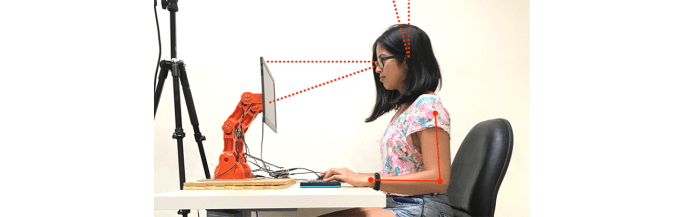
ActiveErgo

Proper ergonomics improves productivity and reduces risks for injuries such as tendinosis, tension neck syndrome, and back injuries. Despite having ergonomics standards and guidelines for computer usage since the 1980s, injuries due to poor ergonomics remain widespread. We present ActiveErgo, the first active approach to improving ergonomics by combining sensing and actuation of motorized furniture. It provides automatic and personalized ergonomics of computer workspaces in accordance to the recommended ergonomics guidelines. Our prototype system uses a Microsoft Kinect sensor for skeletal sensing and monitoring to determine the ideal furniture positions for each user, then uses a combination of automatic adjustment and real-time feedback to adjust the computer monitor, desk, and chair positions. Results from our 12-person user study demonstrated that ActiveErgo significantly improves ergonomics compared to manual configuration in both speed and accuracy, and helps significantly more users to fully meet ergonomics guidelines.

ActiveErgo: Automatic and Personalized Ergonomics using Self-actuating Furniture

Yu-Chian Wu, Te-Yen Wu, Paul Taele, Bryan Wang, Jun-You Liu, Pin-sung Ku, Po-En Lai, and Mike Y. Chen. 2018. ActiveErgo: Automatic and Personalized Ergonomics using Self-actuating Furniture. In Proceedings of the 2018 CHI Conference on Human Factors in Computing Systems (CHI ’18). Association for Computing Machinery, New York, NY, USA, Paper 558, 1–8.
DOI: https://doi.org/10.1145/3173574.3174132