Haptic-go-round

We present Haptic-go-round, a surrounding platform that allows deploying props and devices to provide haptic feedbacks in any direction in virtual reality experiences. The key component of Haptic-go-round is a motorized turntable that rotates the correct haptic device to the right direction at the right time to match what users are about to touch. We implemented a working platform including plug-and-play prop cartridges and a software interface that allow experience designers to agilely add their haptic components and use the platform for their applications. We conducted technical experiments and two user studies on Haptic-go-round to evaluate its performance. We report the results and discuss our insights and limitations.
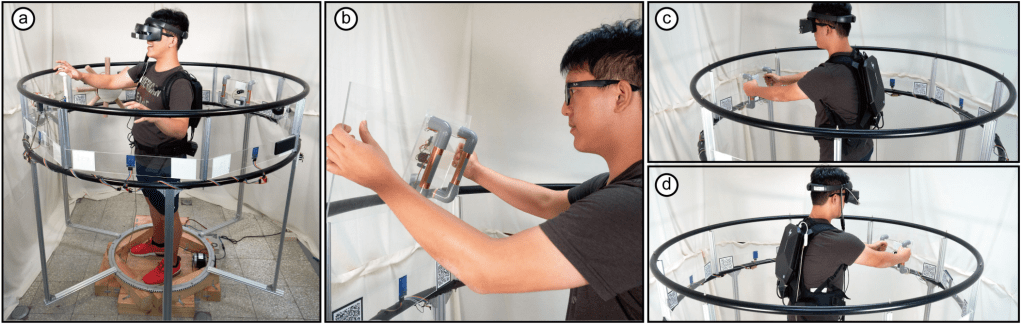
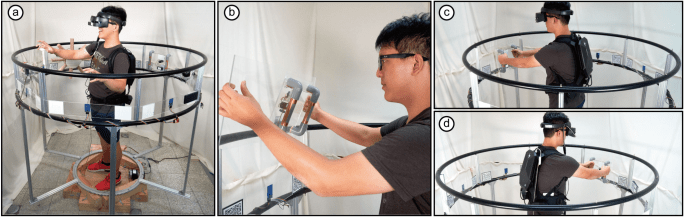
Haptic-go-round is a platform that allows a user to feel haptic feedback when interacting with objects in virtual reality in any direction.

Haptic-go-round: A Surrounding Platform for Encounter-type Haptics in Virtual Reality Experiences

Hsin-Yu Huang, Chih-Wei Ning, Po-Yao Wang, Jen-Hao Cheng, and Lung-Pan Cheng. 2020. Haptic-go-round: A Surrounding Platform for Encounter-type Haptics in Virtual Reality Experiences. In Proceedings of the 2020 CHI Conference on Human Factors in Computing Systems (CHI ’20). Association for Computing Machinery, New York, NY, USA, 1–10.
DOI: https://doi.org/10.1145/3313831.3376476
Miniature Haptics

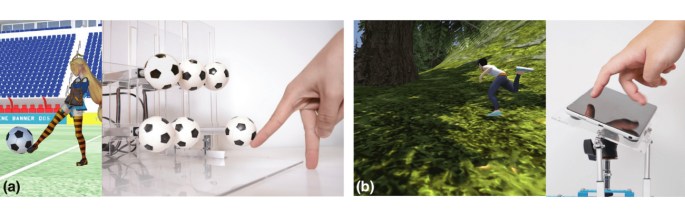
We present Miniature Haptics, a new approach to providing realistic haptic experiences by applying miniaturized haptic feedback to hand-based, embodied avatars. By shrinking haptics to a much smaller scale, Miniature Haptics enables the exploration of new haptic experiences that are not practical to create at the full, human-body scale. Using Finger Walking in Place (FWIP) as an example avatar embodiment and control method, we first explored the feasibility of Miniature Haptics then conducted a human factors study to understand how people map their full-body skeletal model to their hands. To understand the user experience of Miniature Haptic, we developed a miniature football haptic display, and results from our user study show that Miniature Haptics significantly improved the realism and enjoyment of the experience and is preferred by users (p < 0.05). In addition, we present two miniature motion platforms supporting the haptic experiences of: 1) rapidly changing ground height for platform jumping games such as Super Mario Bros and 2) changing terrain slope. Overall, Miniature Haptics makes it possible to explore novel haptic experiences that have not been practical before.

Miniature Haptics introduces the concept of shrinking haptic feedback and applying it to hand-based and embodied avatars.

Miniature Haptics: Experiencing Haptic Feedback through Hand-based and Embodied Avatars

Bo-Xiang Wang, Yu-Wei Wang, Yen-Kai Chen, Chun-Miao Tseng, Min-Chien Hsu, Cheng An Hsieh, Hsin-Ying Lee, and Mike Y. Chen. 2020. Miniature Haptics: Experiencing Haptic Feedback through Hand-based and Embodied Avatars. In Proceedings of the 2020 CHI Conference on Human Factors in Computing Systems (CHI ’20). Association for Computing Machinery, New York, NY, USA, 1–8.
DOI: https://doi.org/10.1145/3313831.3376292

WalkingVibe

Virtual Reality (VR) sickness is common with symptoms such as headaches, nausea, and disorientation, and is a major barrier to using VR. We propose WalkingVibe, which applies unobtrusive vibrotactile feedback for VR walking experiences, and also reduces VR sickness and discomfort while improving realism. Feedback is delivered through two small vibration motors behind the ears at a frequency that strikes a balance in inducing vestibular response while minimizing annoyance. We conducted a 240-person study to explore how visual, audio, and various tactile feedback designs affect the locomotion experience of users walking passively in VR while seated statically in reality. Results showed timing and location for tactile feedback have significant effects on VR sickness and realism. With WalkingVibe, 2-sided step-synchronized design significantly reduces VR sickness and discomfort while significantly improving realism. Furthermore, its unobtrusiveness and ease of integration make WalkingVibe a practical approach for improving VR experiences with new and existing VR headsets.

WalkingVibe prototype with 2 vibration motors behind the ears, which provide vibrotactile stimulation synchronized to footsteps in VR.

WalkingVibe: Reducing Virtual Reality Sickness and Improving Realism while Walking in VR using Unobtrusive Head-mounted Vibrotactile Feedback

Yi-Hao Peng, Carolyn Yu, Shi-Hong Liu, Chung-Wei Wang, Paul Taele, Neng-Hao Yu, and Mike Y. Chen. 2020. WalkingVibe: Reducing Virtual Reality Sickness and Improving Realism while Walking in VR using Unobtrusive Head-mounted Vibrotactile Feedback. In Proceedings of the 2020 CHI Conference on Human Factors in Computing Systems (CHI ’20). Association for Computing Machinery, New York, NY, USA, 1–12.
DOI: https://doi.org/10.1145/3313831.3376847